5 Ergonomic Chairs for Work and Meditation: Dial In
By Owen McKay • 3rd Mar
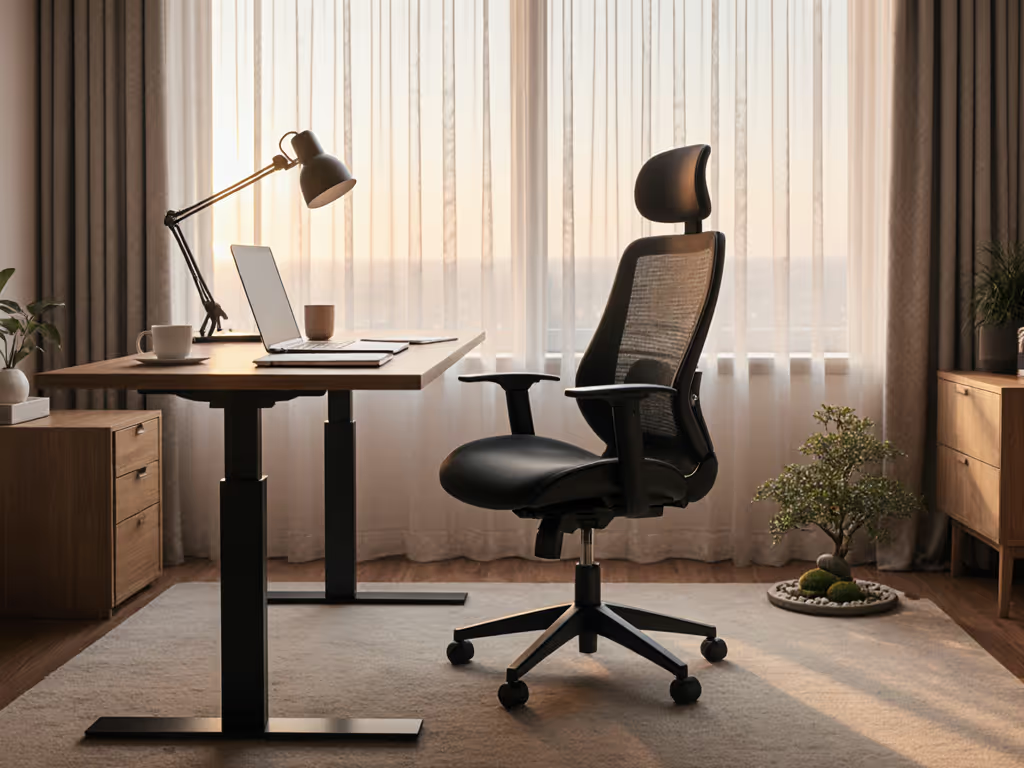
The line between your workday and your practice doesn't have to be drawn at furniture. A task ergonomic chair that doubles as meditation office seating isn't a luxury, it's the pragmatic choice for knowledge workers who want to move fluidly between deep focus and intentional rest without abandoning support. Whether you're navigating a video call or settling into a five-minute breath session, the wrong seat will undo both. This guide walks you through five chairs that excel at the handoff, with the specific dials and measurements that let you own your fit.
I learned this the hard way. On a hectic Monday rollout, my team had twelve people and twenty minutes to get through basic chair setup. For a repeatable process, follow our adjustable chair setup guide. We mapped thigh clearance, dialed tilt tension, set seat depth, and saved each profile on a card. Two weeks later: fewer break tickets, happier shoulders. That's when I committed to the idea that controls are the user interface (the more transparent and accessible those controls, the more people actually use them). Small fit tweaks compound into big comfort and focus dividends.
Why Dual-Purpose Seating Matters
Static sitting is the enemy of both productivity and presence. Build movement into your day with these dynamic sitting techniques. Research confirms that chairs built with ergonomic fundamentals (adjustable lumbar support, seat depth control, and tilt tension) create a stable foundation whether you're typing for eight hours or sitting in meditation for eight minutes. The confusion starts when you hunt for a chair that whispers "professional" while also supporting an upright, neutral spine during breath work.
Most office chairs sacrifice feedback and posture transitions for style. Most meditation seats sacrifice adjustability and durability for portability. A bridge chair (one with intuitive adjustment points and a wide range) gives you both worlds. You're not compromising; you're compounding. Each adjustment you nail down today carries forward into tomorrow's focus.
What to Look For: The Non-Negotiables
Before we walk through the five chairs, here's a quick framework to guide your thinking:
Seat Depth Control: Does it let you adjust forward/backward? A seat that's too deep will press into your thighs; too shallow and your lower back loses support. Most professionals sit 6-10 hours daily and never touch this dial.
Lumbar Height & Firmness: Can you move the lumbar support up/down and adjust tension? This is the single biggest lever for pain reduction. Your low back isn't one-size-fits-all.
Tilt & Recline Tension: Does the chair let you lock the backrest at multiple angles? For meditation, a slight recline (5-15 degrees) keeps your shoulders relaxed. For work, you want firm support with micro-adjustments.
Armrest Geometry: Do the arms pivot, adjust width, and height? Poor armrest design causes wrist and shoulder strain, especially during typing.
Breathability: If you sit for long blocks, mesh or air-permeable fabric prevents heat buildup and fatigue.
Build Quality & Warranty: You're investing in durability and parts support, not brand hype. A chair that lasts ten years and still has warranty coverage for replacement components is worth the premium.
1. Herman Miller Aeron: The Benchmark
Best For: Full-time professionals who sit 8+ hours daily and value proven, no-compromise support.
The Aeron is one of the most iconic ergonomic chairs ever made, and there's a reason it endures. Its patented breathable mesh (called Pellicle) distributes your weight evenly across the seat and back, reduces pressure points, and stays cool throughout long sessions. For meditation practitioners who double as desk workers, this means you won't face the sticky, stagnant feeling that derails presence.
Dial-In Points:
- Comes in three sizes (A, B, C) to match your frame, not a generic "one-size" myth
- Adjustable PostureFit SL lumbar support that you can shift up and down
- Seat depth slides forward and back
- Tilt and recline control with smooth, predictable tension
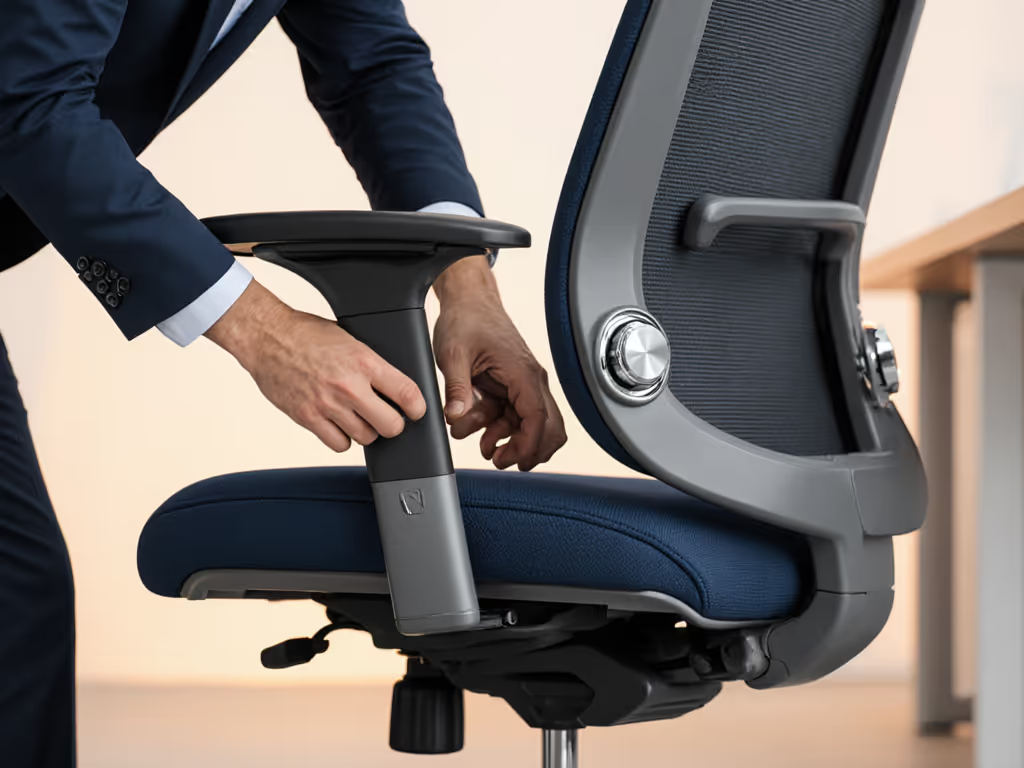
- Armrests adjust height, width, and angle
Why It Works for Both: The mesh back allows micro-movement and keeps your spine aligned during work; the recline mechanism lets you ease back for a calm meditation posture without losing support. The investment (£999-£1,049) is steep, but professional-grade durability means you're not replacing it in three years.
Potential Drawback: Mesh isn't for everyone, if you live in a cold climate, some users find it drafty. The adjustment learning curve is real; you're rewarded only if you take time to dial it in.
2. Herman Miller Embody: Posture Redistribution
Best For: Knowledge workers with a history of lower-back tension who want active support that encourages movement.
The Embody takes an unexpected approach to ergonomic comfort with its pixel-matrix back and seat design, engineered to distribute pressure and actively promote movement throughout the day. Unlike chairs that try to lock you into "perfect posture," the Embody invites you to shift and micro-adjust, a quality that translates seamlessly into meditation, where subtle postural cues ground your attention.
Dial-In Points:
- Dynamic backfit adjustment that responds to your spinal curve
- Back-pressure redistribution system (the pixel-matrix) reduces hotspots
- Seat depth and width adjustable
- Responsive tilt and recline with multiple lock points
- Armrests pivot and adjust for shoulder-width customization
Why It Works for Both: During work, the active support system encourages postural variety, your chair moves with you rather than forcing you into a static mold. During meditation, that responsiveness becomes a feature: your breath and subtle weight shifts translate into chair feedback, keeping you anchored without rigidity. The price point is comparable to the Aeron (£1,082+), but the philosophy differs, you're paying for a chair that teaches you to move.
Potential Drawback: Requires more active engagement than passive chairs; some users find the learning curve steep, and it's not suited to users who prefer a "set it and forget it" experience. For a deeper dive into its unique back and seat design, read our Embody chair analysis.
3. RH Logic 220 High Back Office Chair: Contour & Precision
Best For: Professionals who value spine-specific support and want a medium-to-high-back design that wraps around your shoulders.
The RH Logic 220 provides strong contouring and ergonomic support in a high-profile design, making it excellent for users focused on precision posture alignment. If your meditation or work practice relies on upright, shoulder-supported posture, this is a no-compromise choice.
Dial-In Points:
- Contoured lumbar support (height and depth adjustable)
- Adjustable tilt and seat depth
- Multiple adjustment points for fine-tuning
- High back extends support into mid-thoracic spine
- Armrests adjust to match your typing position
Why It Works for Both: The high back is a feature for long work sessions, it holds your upper spine in neutral during video calls and coding marathons. For meditation, that same support creates a "container" for your posture without constraining breath. The contoured lumbar is particularly valuable if you've battled lower-back pain; users report that the precision adjustability reduces strain in ways generic office chairs can't touch.
Potential Drawback: The high back may feel over-supportive if you prefer a more minimal, open sensation during meditation. It's also a bigger footprint; check your space before purchasing.
4. Ergochair Adapt 630 Series: Affordable Adjustability
Best For: Home-office workers and small-team buyers who need a reliable, fully adjustable chair without the luxury price tag.
The Adapt 630 is positioned as a reliable chair for full-time office use, providing a refined sit with ergonomic balance and adjustability. It's designed for users who sit 6-10 hours daily and want a chair that can be dialed in precisely, and then left alone. For meditation practitioners on a budget, this hits a sweet spot: genuine adjustability without overcomplication.
Dial-In Points:
- Fully adjustable tilt and recline
- Balanced lumbar support (adjustable)
- Seat depth control
- Armrests adjust in multiple planes
- Clean, professional aesthetic that fits any workspace
Why It Works for Both: The Adapt 630 delivers ergonomic fundamentals without complexity. You get the controls that matter (lumbar, tilt, seat depth) and none of the gimmicks. For professionals at fit extremes (petite, tall, or higher-weight users) this chair's adjustability range covers wider ground than many mid-tier competitors. The lower price point (relative to Aeron or Embody) makes it more accessible for team purchases or those testing the dual-purpose concept.
Potential Drawback: It lacks some of the advanced features (like the Embody's pressure-redistribution matrix or the Aeron's iconic mesh). You're buying honest ergonomics, not innovation.
5. Humanscale Freedom Task Chair: Weight-Adaptive Recline
Best For: Dynamic workers who move between sitting and standing, or who want minimal adjustment fuss but maximum responsiveness.
The Humanscale Freedom is a weight-adaptive chair that automatically adjusts recline tension based on your body weight, eliminating the guesswork. For practitioners who meditate, yoga-style breathing, or move fluidly between tasks, this is elegant: the chair adapts to you, not the reverse.
Dial-In Points:
- Weight-adaptive recline (self-adjusting tension)
- Seat depth and height adjustable
- Armrests adjust for typing comfort
- Minimal visual clutter, no complicated levers
- Compatible with sit-stand desks and dynamic workstations
Why It Works for Both: The charm of the Freedom is its simplicity. You don't wrestle with tension dials; the chair responds to your presence. During meditation, that automatic adjustment means you can ease back without second-guessing the mechanics, your weight and breath naturally sink into support. For work, the same responsiveness means your chair moves with your energy throughout the day, not against it.
Potential Drawback: The weight-adaptive system is less hands-on; if you want granular control over every dial, this won't satisfy. Also, at £999+, it's pricey for what you might perceive as "less adjustability." But the philosophy is different: you're paying for invisible engineering, not visible levers.
How These Five Compare: The Quick Dial
| Chair | Best For | Top Feature | Adjustability | Price Tier | Durability |
|---|---|---|---|---|---|
| Herman Miller Aeron | 8+ hour office workers | Breathable mesh, proven design | High | Premium (£999-£1,049) | Excellent |
| Herman Miller Embody | Active postural variety | Pixel-matrix back | Very High | Premium (£1,082+) | Excellent |
| RH Logic 220 | Spine-specific support | High back + contoured lumbar | Very High | Mid-Premium | Very Good |
| Ergochair Adapt 630 | Budget-conscious professionals | Reliable fundamentals | High | Mid-Tier | Good |
| Humanscale Freedom | Minimal-adjustment preference | Weight-adaptive recline | Moderate | Premium (£999+) | Excellent |
Dialing In: Your Five-Minute First Setup
You don't need an hour to dial in your chair. You need focus. Here's a time-boxed checklist that works whether you're alone or coaching a team:
Minute 1-2: Seat Height Your feet should rest flat on the floor (or footrest) with knees at a 90-degree angle. Your thighs should be parallel to the ground, not sloping down or tilting up. Most pain starts here.
Minute 2-3: Seat Depth Adjust the seat forward or back so there's a two-finger gap between the front edge and the back of your knees. Too deep = thigh pressure. Too shallow = no lower-back support.
Minute 3-4: Lumbar Support Find the small of your low back (around L4-L5, roughly where your belt sits). Adjust the lumbar support to align with that point. Then dial the firmness until it feels like support, not a push.
Minute 4-5: Tilt & Armrests Lock the backrest at a slight angle (5-15 degrees) and adjust armrests so your elbows sit at 90 degrees while typing. Record these settings on a card and tape it under your desk. You'll adjust them again in two weeks when your body knows the chair.
Small Tweaks, Big Dividends
The chairs in this guide aren't interchangeable. Each one invites a different relationship with your body and your work. The Aeron rewards mesh devotees and long-day sitters. The Embody suits practitioners who want active feedback. The RH Logic rewards precision-posture seekers. The Ergochair Adapt suits pragmatists on a tighter budget. The Humanscale suits minimalists who want their gear to disappear.
What matters is this: once you choose a chair and dial it in properly, stay with it for two weeks before tweaking further. Here's what the adjustment period looks like so you know what's normal. Your nervous system needs time to learn the new baseline. Pay attention to your shoulders, your low back, and your end-of-day energy. Small adjustments compound. A quarter-turn on your lumbar dial, a forward nudge on your seat depth, these become the difference between a Friday with back pain and a Friday with clarity.
Your Next Move: Measure Once, Buy Once
Before you purchase, take three measurements and write them down:
-
Your height – Knowing whether you're petite, standard, or tall helps you choose the right size (Aeron, for example, comes in three sizes).
-
Your inseam – This determines seat height range. A 28-inch inseam is very different from a 36-inch inseam in terms of adjustment range.
-
Your torso length – This guides backrest height and lumbar support positioning. Your low back isn't where everyone else's is.
Use these numbers to cross-reference each chair's adjustment range. Most premium chairs publish detailed specs; if they don't, that's a red flag. You're looking for chairs where controls are the user interface, transparent, labeled, and honest about their range.
Then, before committing to a full purchase, see if you can test one in person or rent short-term. Many suppliers offer trial periods. Spend 30 minutes in the chair, do your five-minute setup, and ask: Does my body trust this? If the answer is yes after a real sit, you've found your match. If not, the next chair on this list might be waiting.
The goal isn't the perfect chair. It's a chair that fits you, that you've dialed in properly, and that you're confident enough to sit in all day without second-guessing your posture. That's when meditation becomes possible at your desk, and when deep work becomes sustainable. That's when small tweaks start compounding into the comfort and focus dividends that make the investment worthwhile.
Related Articles