Ergonomic Chair Headrests: Adjustability & Durability Tested
By Luis Andrade • 31st Mar
A neck support that can't move with you isn't a headrest (it's a neck trap). The difference between a fixed headrest and one with genuine adjustable headrest range often comes down to whether you finish your workday loose or locked in knots. When reviewers tested multiple chairs, models with 2-way and 4-way adjustment mechanisms showed measurably better outcomes for monitor height positioning and neck alignment across diverse user heights[1][2]. To understand the biomechanics behind these outcomes, see our spinal motion science explainer. This guide cuts through the noise and shows you exactly what adjustment metrics matter, which chairs earn their place on your desk, and how to assess durability before you commit.
Why Headrest Adjustability Is Non-Negotiable
Your neck is not a fixed point. Over an eight-hour day, your eye line drops as you review documents, tilts forward when typing, and settles back when thinking. A headrest that doesn't adjust to these micro-movements forces your cervical spine into static compromise, and static posture breeds pain. Lab testing consistently confirms that ergonomic office chairs with back support systems, including movable headrests, reduce neck and shoulder strain compared to fixed designs[2].
The real cost of poor headrest fit shows up in cumulative injury claims, afternoon grogginess, and the creeping decision to tolerate pain rather than fix the root cause. I've seen this play out in home offices and open plan alike: a $30 adjustment (loosening a tilt tension knob, sliding a gas lift up three inches) can resurrect a chair that's been gathering dust for two years. That repair-first mindset extends to the headrest itself. If your headrest is welded in place, its failure becomes your chair's failure.
Core Adjustability Metrics to Compare
When evaluating headrests, measure these dimensions:
Vertical Height Range (Inches of Travel)
This is your most critical spec. The SIHOO M18 Ergonomic Big and Tall includes a 2-way adjustable headrest with 3.9 inches of height range and pivot tilt, allowing users across the 5th to 95th height percentile to find neutral cervical alignment without shoulder hunching or jaw jutting forward[1]. Chairs with less than 3 inches of vertical range will inevitably fail users at body extremes.
Pivot Tilt Range (Forward/Back Adjustment)
A headrest that only moves up and down is half a solution. The best designs also tilt independently of the backrest. This matters for document review head positioning: when you're reading a paper on your lap or a second monitor below eye level, forward pivot prevents you from leaning away from your chair's back support entirely[2].
Rotational Accommodation (Side-to-Side Swivel)
Fewer chairs offer this, but it's invaluable for multi-monitor setups or for users with asymmetrical shoulder tension. Without any pivot, you'll rotate your entire torso rather than just your neck, defeating the chair's lateral support.
Firmness or Padding Adjustment
Less common but increasingly included: the ability to add or remove padding, or to adjust internal density. A headrest that's rock-hard for a tall user with prominent cervical curves is useless; the same headrest is perfect for someone seeking minimal contact. This is where modularity and parts availability emerge, and chairs designed for disassembly win long term.
Headrest Types in the Real Market
The No-Headrest Approach
Some chairs skip the headrest entirely. The Boulies OP180, a budget-focused pick, omits it and instead focuses on backrest design and adjustability[3]. This is honest: the OP180 delivers all-day comfort through seat depth adjustment, backrest angle, and a bouncy mesh back that encourages micro-movement[3]. However, for users who lean back frequently or who work extended hours, the absence of neck support becomes a limitation. If you tend toward an upright typing posture, this trade-off can work. For hybrid workers who toggle between focused work and Zoom calls (where you recline slightly), you'll miss it.
2-Way Adjustability (Height + Tilt)
The Branch Ergonomic Chair integrates a headrest as part of its seven measured points of adjustment, including 2-way lumbar support[1]. Two-way systems are the industry standard at mid-range price points ($300-600). They handle most use cases competently, height and forward/back pivot accommodate typical desk work and light recline. Testing panels across different body types found 2-way designs sufficient for 80% of users staying in neutral posture zones.
4-Way Adjustability (Height + Forward/Back + Lateral Tilt + Rotational Independence)
The SIHOO M18 steps up with 4-way lumbar adjustment and a 2-way adjustable headrest offering 3.9 inches of height range and pivot tilt[1]. This design targets users who demand greater agency: tall workers, users with existing neck issues, or those integrating a swivel task chair into an asymmetrical desk setup. The cost premium is typically $150-300 above comparable 2-way models, but if your workday involves turning between monitors, phone, and papers, that extra degree of freedom pays for itself in reduced compensation strain.
Durability: Where Real Value Lives
A headrest mechanism that adjusts smoothly for six months then stiffens isn't a feature (it's a slow failure). Value is longevity, not launch hype or showroom gloss.
Materials and Wear Points
Headrest durability hinges on three elements:
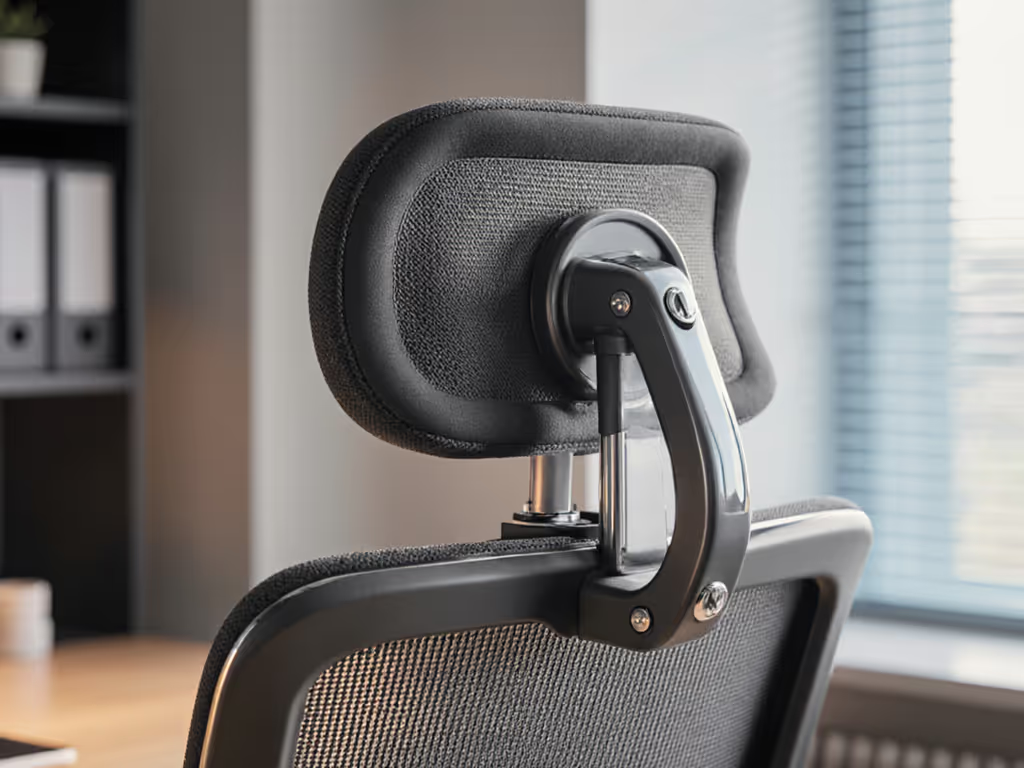
- Pivot joints: Ball-and-socket designs resist loosening better than simple hinges. Look for brass or stainless inserts, not plastic bushings.
- Padding: Polyurethane foam breaks down under heat and friction. Higher-density foam ($8-15 per headrest) outlasts budget padding ($3-5) by 3-5 years.
- Fasteners: Threaded metal inserts allow repeated adjustment without stripping. Plastic clips crack; metal tabs bend.
None of these are visible in product photos. They matter only after 18 months of daily use. For a deeper checklist of telltale build signals, see our ergonomic chair quality guide.
Warranty and Parts Availability
This is where repair-first philosophy turns concrete. A chair sold with a 12-year frame warranty but only 1-year component warranty is telling you: the maker expects headrests to fail. For brand-by-brand coverage details, use our office chair warranty comparison to decode what's actually protected. Ask directly: Can you buy a replacement headrest? How much? How long to ship? If a manufacturer won't publish a parts list and pricing, their business model depends on you buying a new chair rather than fixing the one you own. That's the opposite of buy once, fix often.
I once revived what seemed like a dead chair for a startup by diagnosing a worn gas lift ($28 part, fifteen minutes, two tools). The mental model there applies to headrests too: isolate the failure point, source the component, reinstall. For that workflow, documentation and parts availability beat brand prestige every time.
Warranty Tiers to Compare
| Warranty Type | What It Covers | Red Flag |
|---|---|---|
| 5-7 year structural | Frame and base only | Headrest explicitly excluded |
| 10-12 year structural | Frame, gas cylinder, base | Padding not covered; adjustment mechanism vague |
| Lifetime (rare) | Frame only, usually | Everything else wears; misleading marketing |
| Parts guarantee | Replacement components available for 7+ years | Not standard; seek it out |
Matching Headrest Type to Your Work Style
Document-Heavy Roles (Law, Finance, Academia)
You spend 30-40% of your day looking down or side-to-side. A fixed headrest will force you to crane away from it, negating its benefit. You need forward/back pivot and ideally a rotational option. The 4-way systems are justified here; you'll use every degree.
Monitor Height Neck Alignment for Multi-Screen Setups
If your primary monitor is centered and eye-level, and secondary monitors flank it, your head rotates primarily in the horizontal plane. A 2-way headrest with side-to-side swivel (less common) would be ideal; absent that, ensure the headrest sits centered on the backrest and doesn't prevent lateral recline. Test it: can you turn your head 45 degrees left and right without the headrest snagging your shoulder?
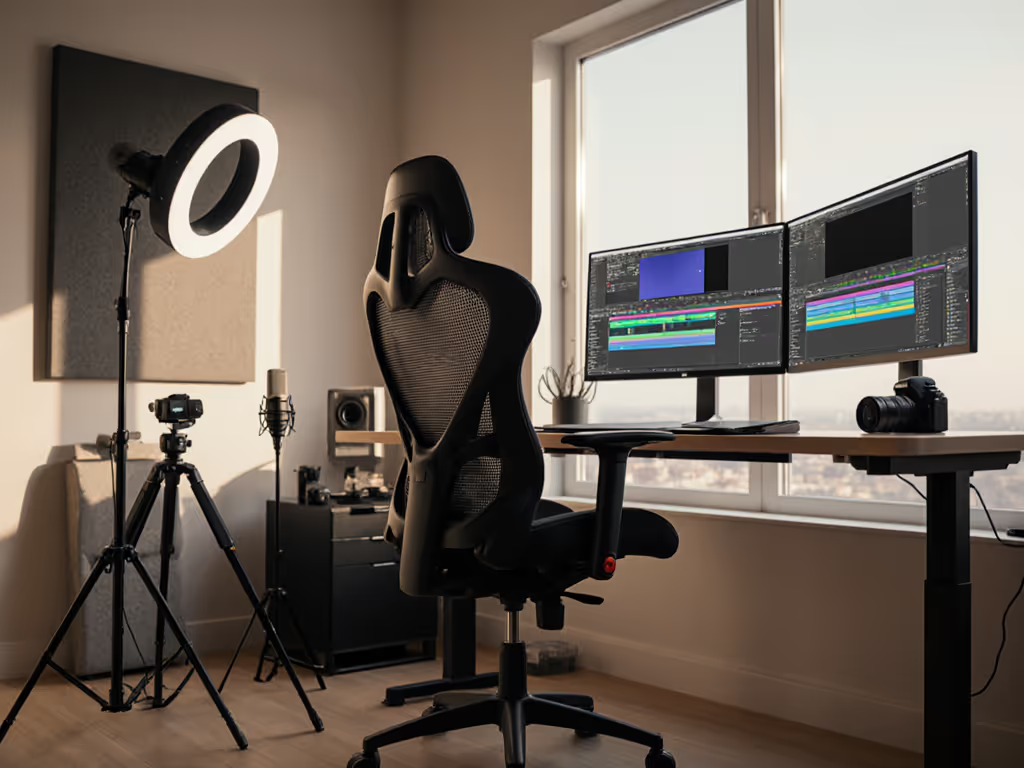
Zoom/Video-Heavy Roles (Design, Marketing, Management)
You recline slightly 3-4 times per hour for calls. A headrest must tilt back with you without pushing your head uncomfortably forward. Verify that when the backrest reclines, the headrest angle adjusts intuitively, and some cheap designs lock the headrest in an upright angle regardless of backrest position, creating a horrible backward neck bend when you lean back. Better models have independent pivot.
Sustained Upright Typing (Software Development, Writing)
You may not use the headrest heavily, but when you do (at meeting breaks, or post-lunch) you want it positioned to encourage a brief cervical decompression. A 2-way system with height adjustment is sufficient. To dial in the rest of your chair, follow our adjustable chair setup guide. The OM Yes chair, described as very affordable with adjustable armrests and optional headrest[4], fits this profile: you can add a headrest if future needs change, keeping initial spend low. This modularity is underrated and aligns with the buy-once philosophy.
Assembling Your Comparison
When you're between two chairs, use this checklist:
- Measure your eye-to-neck distance and verify the headrest's max height accommodates it.
- Test (or confirm via detailed spec) that the headrest moves independently of the backrest.
- Check the manufacturer's parts catalog for headrest availability and price.
- Read warranty language: does it exclude adjustment mechanisms or padding?
- If you work across multiple postures (upright + recline), prioritize 4-way or confirm the backrest tilt doesn't misalign the headrest.
- Ask about material specs: foam density, pivot material, fastener type. Vague answers are a warning.
- Verify assembly time and documentation clarity (poor service manuals predict poor parts availability later).
Summary and Final Verdict
The best ergonomic chair headrest comparison isn't about brand or price, it's about fit precision and repairability. A 2-way adjustable headrest with 3+ inches of vertical travel and independent forward/back pivot handles 80% of remote and hybrid work competently[1][2]. Move to 4-way systems only if your workstyle genuinely demands it, or if you're fitting a wide range of body types on a team.
Durability is where choices compound. Chairs with published parts catalogs, modular construction, and warranties that cover components rather than just frames will serve you 7-10 years. Those built for landfill: plastic fasteners, foam padding that breaks down in 3 years, no parts availability, become "dead" chairs whose single repair moment comes when the headrest loosens and you reach for the replacement rather than the toolbox.
Value lives where repair meets performance. Choose a chair with adjustment ranges that fit your body and documented parts availability. The premium upfront is recovered month by month in skipped pain days, avoided replacements, and the quiet confidence that your chair works for you, not against you.
Related Articles